AI in facility management is shifting from experimental pilots to everyday operational execution as property and plant leaders manage tighter budgets, aging assets, and rising energy costs. According to the 2026 AI & Digitalization in Facilities Management Report highlighted by IFMA, 67% of facilities teams already use AI to improve operations, and 61% plan to expand adoption over the next year. For organizations across Vietnam running offices, commercial buildings, and industrial plants, pairing smart tools with disciplined on-site execution is becoming essential to protecting uptime and controlling operating expenses (OPEX).
AI in Facility Management: Opportunities for operational efficiency
Why Artificial Intelligence in Facilities Management Is Accelerating Now
Facility managers today sit at the intersection of operational technology (OT) and information technology (IT) while carrying broader responsibilities than ever before. Rising utility rates, skilled labor shortages, and deferred maintenance on older equipment leave little room for reactive firefighting.
Instead of adopting technology purely for novelty, facility leaders are turning to artificial intelligence in facilities management to solve concrete operational bottlenecks. When equipment fails unexpectedly or HVAC and lighting run unchecked during low-occupancy hours, costs compound quickly. Smart analytics help teams spot anomalies earlier, prioritize limited maintenance hours, and connect daily site work to measurable financial and sustainability goals.
Top Insights From the 2026 AI & Digitalization Report
Insights from the 2026 IFMA report show where facility teams are focusing their budgets—and where they are running into friction. Three patterns stand out across modern building and plant operations:
Energy performance is the number-one priority: Rising energy costs rank as a top operational challenge, making energy tracking, optimization, and control the leading current and planned use case for AI and smart building tools. Among facility managers, 22% say optimizing energy performance holds the greatest long-term potential for AI.
Data quality and integration are the biggest hurdle: While enthusiasm is high, 20% of facility managers cite data quality or system integration challenges as the top barrier to scaling AI—ahead of budget limits (19%) and cybersecurity or privacy concerns (17%). Siloed building management systems, legacy meters, and inconsistent logs prevent models from delivering reliable recommendations.
Aging infrastructure and budget pressure demand smarter prioritization: Equipment age and tight budgets threaten uptime alongside cyber risks. Rather than replacing every asset at once, teams use predictive insights to extend equipment life and focus preventive work on high-risk systems.
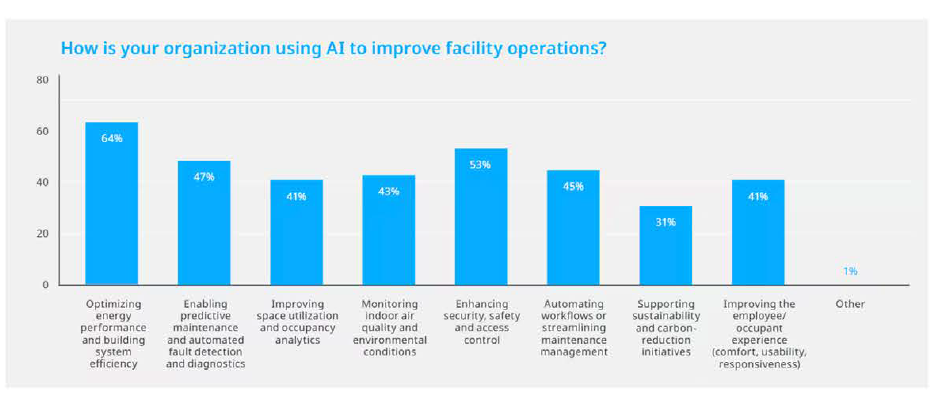
Chart illustrates improvement of AI to facility operations
High-Value Use Cases for AI-Driven Facility Operations
Successful deployments start with narrow, high-ROI workflows rather than sprawling overhauls. Across commercial properties and industrial sites, four practical applications deliver clear value:
Energy Optimization and Demand Control
AI algorithms analyze occupancy schedules, weather patterns, and utility tariffs to fine-tune HVAC setpoints, lighting schedules, and peak demand loads. Even modest percentage reductions in electricity and cooling bills compound month after month and directly support corporate ESG targets.
AI-Driven Predictive Maintenance and Uptime
Rather than relying solely on fixed calendar intervals or waiting for breakdowns, AI-driven predictive maintenance combines sensor readings, vibration or temperature trends, and historical service logs to flag early signs of wear. Catching a failing bearing or chiller issue early reduces emergency repair premiums and keeps production lines or office systems running smoothly.
Smarter Work Order Routing and Space Utilization
Automated ticketing and triage can route maintenance requests to the right technician with clear priority levels, cutting administrative delays. In offices and multi-use facilities, occupancy and utilization data also help teams right-size cleaning schedules, meeting room allocation, and workspace layouts.
Overcoming Data Silos and Execution Gaps on Site
Even the smartest software cannot fix messy underlying data or unexecuted field tasks. A sensor alert only prevents downtime if trained technicians, cleaners, and security or site teams follow standardized procedures on the ground.
To build a strong foundation before scaling AI across a portfolio, facility teams should focus on three practical steps:
Audit data sources first: Map out existing meters, building automation systems, CMMS logs, and manual checklists to see where data is accurate, complete, or disconnected.
Start with one measurable pilot: Pick a single building, system, or workflow—such as chiller scheduling or recurring work orders—and track clear baseline metrics over 30 to 90 days.
Align digital insights with field SOPs: Ensure on-site technicians and service partners have clear escalation rules, safety compliance, and standardized reporting so digital alerts translate into real-world reliability. For broader industry benchmarks and research frameworks, facility teams can also consult the IFMA Knowledge Library.
Partner With DAS Services for Reliable Facility Operations

DAS – You focus on your business, we focus on supporting you
Technology works best when backed by disciplined people, clear processes, and responsive local support. Whether you manage a commercial tower, corporate office, hospital, or manufacturing plant, DAS Services comprehensive facility solutions help optimize operating costs, maintain equipment reliability, and uphold international service standards.
Looking to streamline maintenance, technical upkeep, or integrated site operations for your property? Get in touch with the DAS Services team today to discuss a tailored plan for your facility.